Every box of pastry. Several products. Several lots.
Every box of Chinese pastry has to be traceable back to its ingredient lots, and every box needs a calculated shelf life. That is daily work at Jiu Zhen Nan, a brand dating back to 1890 — and it is the hardest part of lot traceability in a food plant.
Why would a company with more than a century of history hand its factory systems to a vendor it had never heard of? At the first visit, Jiu Zhen Nan said plainly that they did not know AMASTek, and were unsure about handing the work over. What changed their mind was another AMASTek customer speaking from experience. That plant had been running the system for some time and described exactly how it went — including a first year with little visible difference, and a second year in which the benefits began to show. Hearing it from an actual user, Jiu Zhen Nan decided to give AMASTek a try.
Customer Profile
Customer | Jiu Zhen Nan Foods Co., Ltd. |
|---|---|
Brand origin | Since 1890; now based in Daliao District, Kaohsiung |
Industry | Food manufacturing (Chinese pastry; gluten-free production line) |
Systems | AMAS PMS smart manufacturing platform: shop-floor MES, smart warehouse WMS, secondary packaging management, plant energy monitoring |
Integration | SAP ERP |
The challenge: SAP is complete, but the shop floor could not use it
Purchasing, work orders and inventory all run in SAP. The problem was the interface: too complex for shop-floor use, so data had to be keyed in by designated staff at each station.
Gift boxes were the second difficulty. A single box holds several products from several lots, and every peak season meant assigning people to raise orders in SAP and chase progress. This points to something especially visible in food manufacturing: a specification written away from the floor tends to drift from the way work is actually done — however complete the screens look, if the steps do not match, the system goes unused.
Why AMASTek: walk the floor first, write the specification second
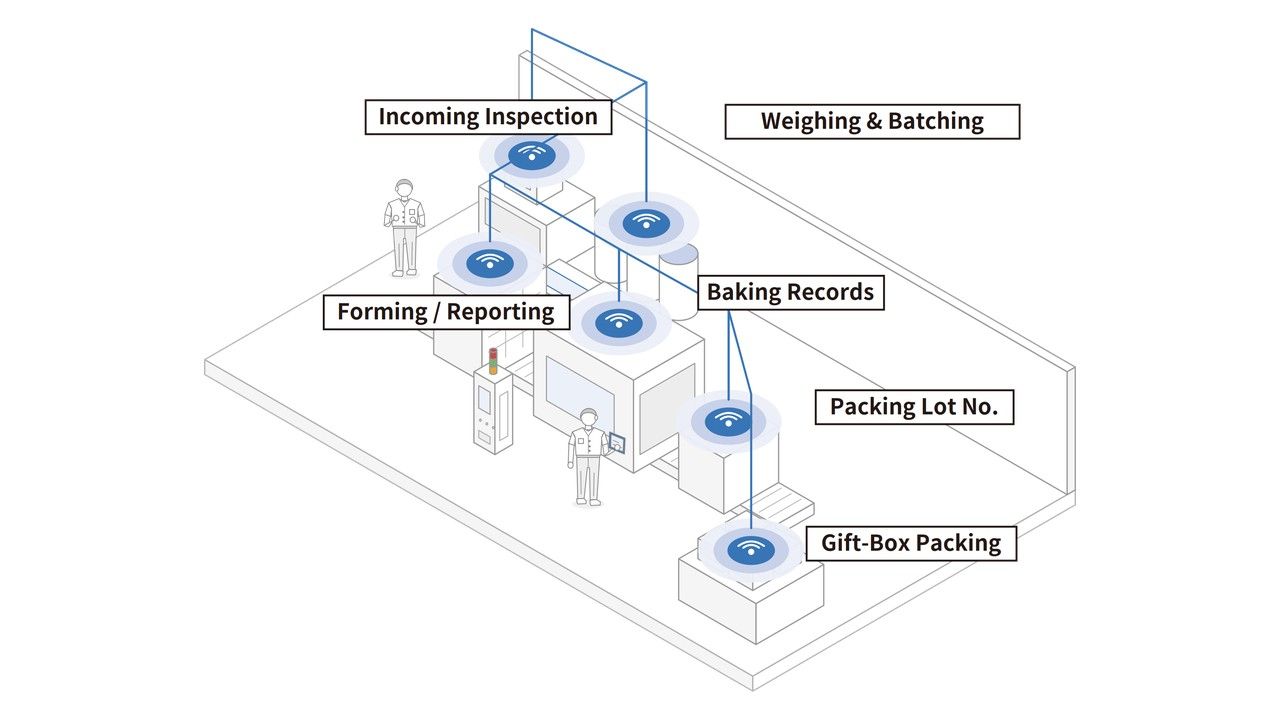
AMASTek did not start by writing code. It asked the operators to walk through their work station by station — from incoming goods and inspection, to weighing and batching, filling and dough preparation, forming and baking. Every step and every paper form was mapped first, then written into a specification that Jiu Zhen Nan reviewed and signed off before development began.
The analysis phase took a long time, but the difference was visible in comparison: AMASTek started from the floor and built something the floor could actually use. Before the first phase was even finished, Jiu Zhen Nan asked AMASTek to take over the warehouse system as well. Some phases were also supported by government programs, which allowed the rollout to land in stages.
The rollout: one lot number, from ingredient to gift box
Shop-floor MES | Each station uses an industrial tablet instead of keying into the ERP. Lot numbers created at incoming inspection are tracked through batching, forming, baking and packing, with station-to-station handovers linked automatically.
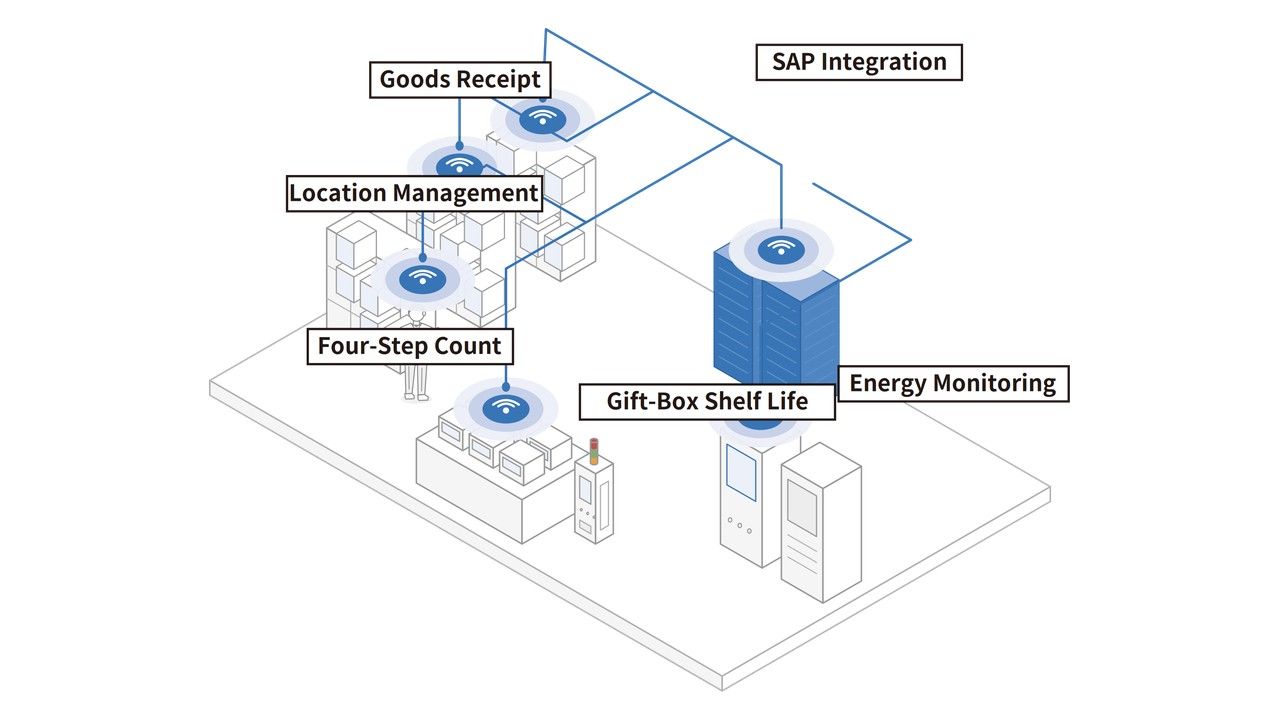
Smart warehouse WMS | Goods receipt and inspection check temperature, sugar content and shelf-life criteria automatically; transfer orders are generated from SAP requirements; counting runs through four steps — first count, recount, team leader and supervisor.
SAP integration | The system follows the data logic and review points already established by Jiu Zhen Nan’s IT team; data is written back to SAP only after it is confirmed and released.
Secondary packaging and gift-box assembly | The system brings up the box composition from the work order, binds each product’s lot number as the box is assembled, calculates the combined shelf life automatically, and links the cases to the shipping order.
Continued expansion | Batching room, work-order progress boards, inventory alerts, first-article inspection, electronic approval, custom gift boxes and plant energy monitoring have been added over time.
What changed
Area | Change |
|---|---|
Shop floor | No need to operate SAP; tablets report station by station, and data is written back once confirmed |
Lot traceability | From incoming inspection to gift-box shipment, every box can be traced to the lot and shelf life of each product inside |
Peak-season workload | Assembly and case-packing data is carried forward from earlier steps, so staff only confirm — easing the order-entry workload at peak |
Approvals | Receiving and production handover records are approved online by supervisors |
Energy | Plant energy use is monitored continuously by zone |
Why AMASTek
Strength | How it worked at Jiu Zhen Nan |
|---|---|
Requirements analysis that starts on the floor | Operators interviewed and every station mapped before the specification was written |
Project managers who came up through engineering | They understand development and go out to the line — looking at problems and discussing them where the work happens, which built trust across departments |
Closing the last gap between ERP and the floor | SAP is not replaced; the hard-to-use screens are replaced by tablet workstations, following the customer’s existing review process |
Handling complex food-industry flows | Multi-product, multi-lot pastry gift boxes, with shelf life and lot numbers bound at the moment of assembly |
What comes next
Two directions are in planning. The first is quality: Jiu Zhen Nan has its own AI visual inspection, and the plan is to integrate it with the production system so results flow straight into production records. The second extends from the plant to the stores: once secondary packaging generates labels, store counting and first-in-first-out become clearer.
FAQ
1. We already have SAP — do we still need an MES?
SAP is strong at master data, work orders and inventory, but awkward on the shop floor. An MES lets operators report station by station on tablets, with data written back to SAP after confirmation. The two divide the work rather than replace each other.
2. Our operators are not comfortable with computers. Will they use it?
AMASTek interviews operators before writing the specification, designs screens around the actual sequence of work, and uses barcode scanning in place of extensive manual entry.
3. A gift box contains several products from several lots — how is it traced?
Each product’s lot number is bound as the box is assembled, and the combined shelf life is calculated automatically. Cases are then linked to the shipping order, so any box can be traced back.
4. Can it be rolled out in phases?
Yes. Jiu Zhen Nan began with the shop-floor workstations and the warehouse, then added secondary packaging, counting, inventory alerts and energy monitoring as operations required.
Wondering how an MES and SAP fit together in a food plant? Talk to AMASTek about digitizing your shop floor.
One minute, several hundred meters.
That is the top line speed of Jung Shing Wire's enamelling lines. Once enameled wire production starts, the line cannot stop — stop it, and the oven temperature and speed change, and so does the quality.
So if the first-article quality decision comes even a little late, the problem is no longer just one spool: wire produced before the decision may have to be scrapped, and recovering the copper costs energy all over again.
One machine. One line. One plant. One supply chain. This is the story of how a listed enameled wire manufacturer, founded in 1971 and rooted in Tainan for more than fifty years, worked with AMASTek to turn “waiting” into data that can be seen, traced and improved.
Customer Profile
|
Customer |
Jung Shing Wire Co., Ltd. (TWSE: 1617) |
|---|---|
|
Founded / HQ |
1971; Rende District, Tainan, Taiwan |
|
Industry |
Enameled wire, used in electronic components, electric vehicles and other high-tech industries |
|
Scope |
Production reporting on enamelling lines, first-article inspection, plant-wide production reporting, supply chain quality platform, AI quality analysis |
Three Challenges on the Line
First, waiting for the first-article decision. After the first article comes off the line, production keeps running. The team leader performs an initial check at the line, then sends it to QA for instrument measurement. But no step — from the line, to hand-off, to decision — had a time record, so no one could say where delays occurred.
Second, handwritten records everywhere. Production reports, alarm handling, even the wire diameter on labels were copied by hand — slow and error-prone.
Third, customers need every segment to be good. A spool of enameled wire runs several kilometers, and on the line only the surface can be inspected. Downstream customers, however, cut it into pieces one or two centimeters long to make micro coils, and inspect every piece. Ensuring quality along the full length has long been Jung Shing's challenge.
Start small: one enamelling machine — and make sure operators want to use it
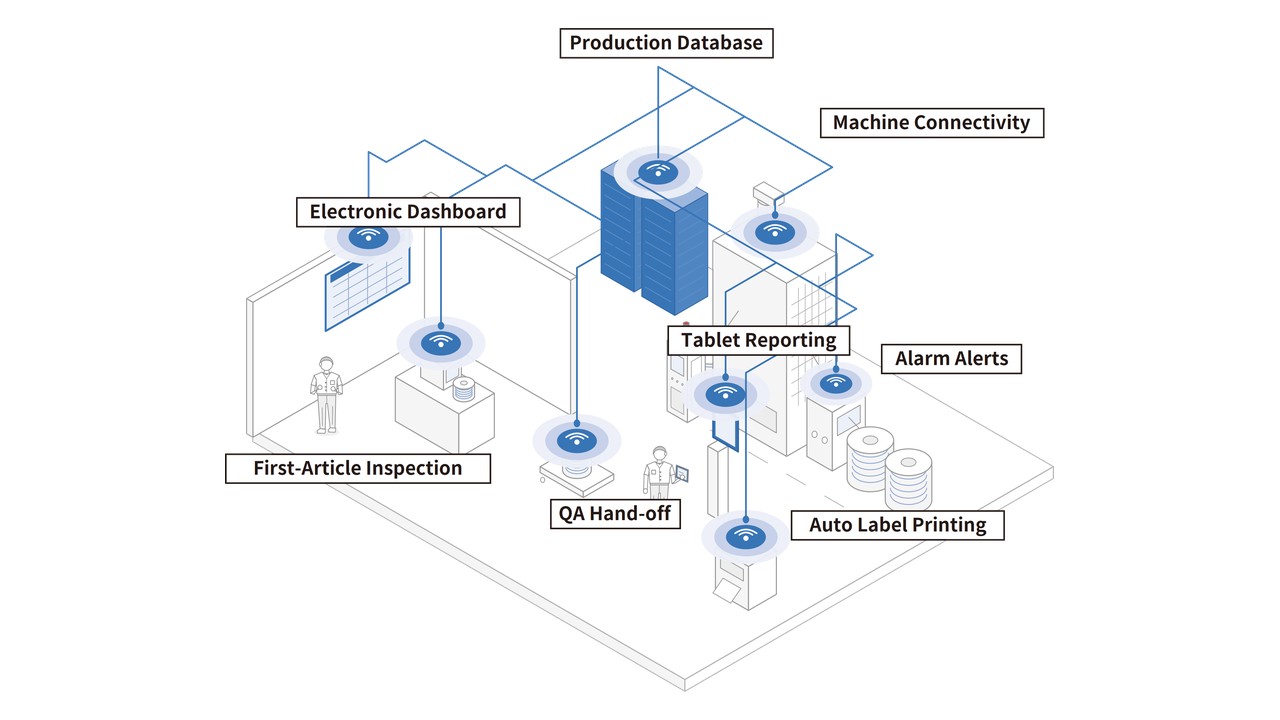
AMASTek did not start with a plant-wide rollout. It began with Industrial IoT (IIoT) machine connectivity for one enamelling machine on one line.
The key was operator acceptance. AMASTek combined industrial tablets, barcode scanning and photos; large icons let operators handle production reporting (output, labor hours and exceptions) with a few taps, typing only to describe problems. Wire diameter is filled in automatically, alarms are notified in real time with handling records kept, and each finished spool gets an automatic number and printed label.
With less copying and fewer errors, operators readily adopted the system.
Connect the workflow: production and QA, so every minute of first-article inspection is recorded
The next step was not a second production line, but the cross-department process from production to QA.
The team leader's paper inspection sheet became an electronic form on the tablet, with basic data and parameters such as temperature filled in automatically — only on-site measurements need entering. A label scan records the hand-off to the QA room, and QA's start and completion of testing are time-stamped too.
Once all the time points were visible, the answer was often not “someone slacking.” On start-up days, with several lines starting at once, team leaders busy adjusting the next line forgot to send finished first articles — something no one had known before. So the QA room got an electronic dashboard: if an inspected first article has not been handed over within 5 minutes, it prompts QA staff to collect it.
This is also the energy-saving example AMASTek shares most often. Typical carbon reduction means variable-frequency motors or high-efficiency equipment; what software can do is produce one less kilometer of defective wire. With annealing and enamel curing at several hundred degrees, every kilometer carries carbon emissions.
Scale up: digitize the whole plant without waiting for every machine to be retrofitted
Next came bringing every enamelling line on board. But the machines span different generations, and connecting them one by one is slow and expensive.
The solution was a tiered rollout: connected machines are fully automated, while machines not yet retrofitted report production using existing label barcodes and online inspection data, with manual entry filling the gaps. Plant-wide production reporting does not have to wait for full machine connectivity.
Extend beyond the plant: quality across the supply chain
Everything so far happened inside the plant, but quality is shaped outside it too. For enameled wire, the most critical raw material is the enamel coating.
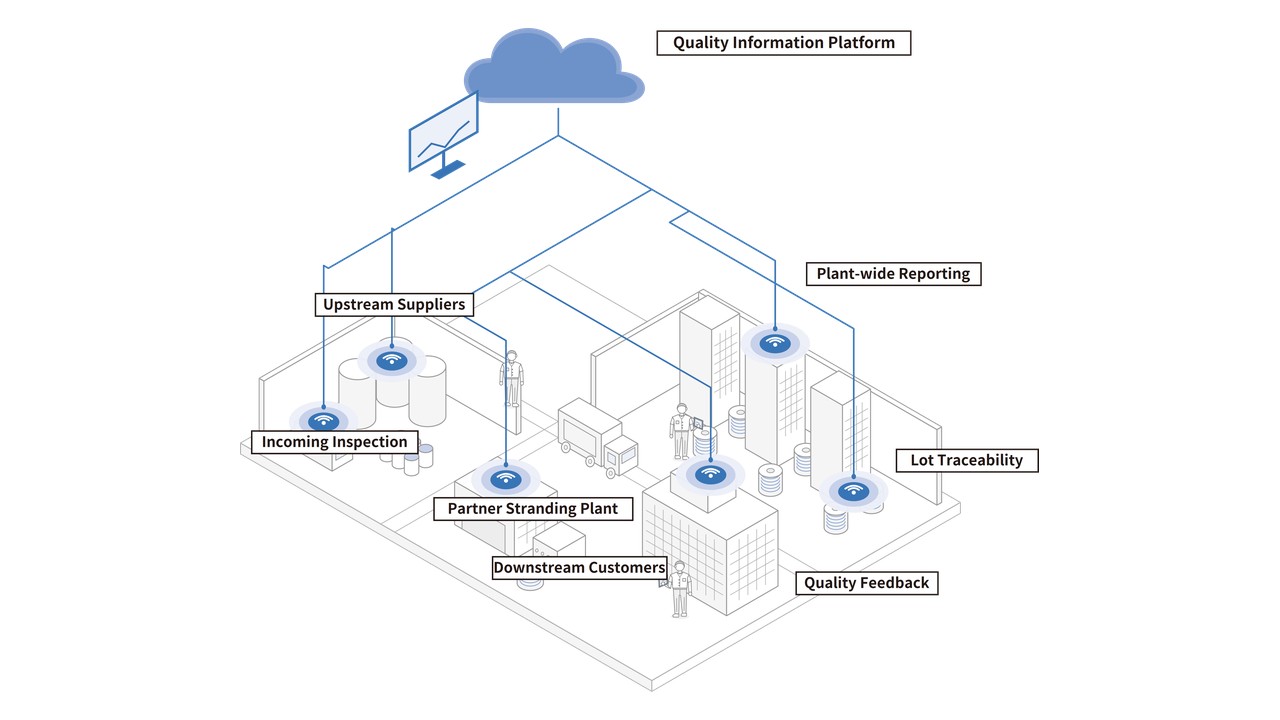
AMASTek built a supply chain quality platform that connects three directions:
Upstream | Shipping inspection data from coating and other suppliers flows into the platform and follows the lot number into production traceability. When a complaint comes in, it can be traced to the raw material lot and its incoming inspection results.
Downstream | Customers check shipping inspection reports and report quality issues on the platform. Quality communication used to be handled one-on-one by sales; now every case leaves a searchable record.
Horizontal | The partner wire stranding plant also adopted production reporting, with its data flowing into the same platform.
AI: From seeing problems to predicting them
Once data accumulates, the next question is: can we know before defects happen?
Jung Shing and AMASTek have begun analyzing production and inspection data to identify the key factors affecting quality. The next step is to predict, from raw materials, process parameters and real-time inspection results, the probability that a spool will have defects and cannot be shipped.
What Changed
|
Area |
Change |
|---|---|
|
Shop floor |
Paperless production reporting, alarm handling and label printing, with less copying time and fewer errors |
|
First-article decision |
Every step from line to hand-off to completed inspection is time-stamped, with automatic overdue alerts |
|
Energy saving |
Defects caught earlier, reducing scrap |
|
Plant-wide reporting |
Tiered rollout for new and old machines — digitized without waiting for retrofits |
|
Supply chain |
Upstream, downstream and partner quality data in one platform; complaints traceable to raw material lots |
Why AMASTek: Not just building systems, but finding resources for transformation
The first thing AMASTek did was prove, with a single machine, that operators would actually use the system.
The second was making sure every step had resources behind it. After the first machine, AMASTek helped plan a matching government program for each phase of Jung Shing's expansion — starting with small consulting projects, then scaling up to supply chain integration. Government support shares part of the investment burden, so the company sees results before deciding on the next step.
That is AMASTek's strength: we understand both production lines and government programs. We know which needs fit which programs, and we break transformation into phases that can be implemented and verified. Today, AMASTek's role at Jung Shing has grown from system vendor to a consulting and implementation team for digital transformation and AI adoption.
FAQ
1. Can older machines without connectivity still be digitized?
Yes. Jung Shing used a tiered rollout: connected machines are fully automated, while machines not yet retrofitted report production with existing label barcodes and inspection data — no need to wait for every retrofit.
2. How can software help manufacturers save energy and cut carbon?
By making fewer defects. With every first-article step time-stamped and overdue alerts in place, defects are caught sooner, reducing the energy spent on scrap and rework.
3. Can smart manufacturing projects be combined with government subsidy programs?
It can be evaluated. AMASTek helps companies plan suitable government programs and project scope based on their current stage and needs. Jung Shing started with small consulting projects and gradually expanded to the supply chain.
4. Where should smart manufacturing start?
Start small. Pick the machine or process with the most obvious pain and the fastest visible results, prove that operators will use it, connect it across departments, then scale it plant-wide. Jung Shing started with one enamelling machine and went all the way to the supply chain and AI.
Where could your production line start? Talk to AMASTek about your smart manufacturing and government program planning.